
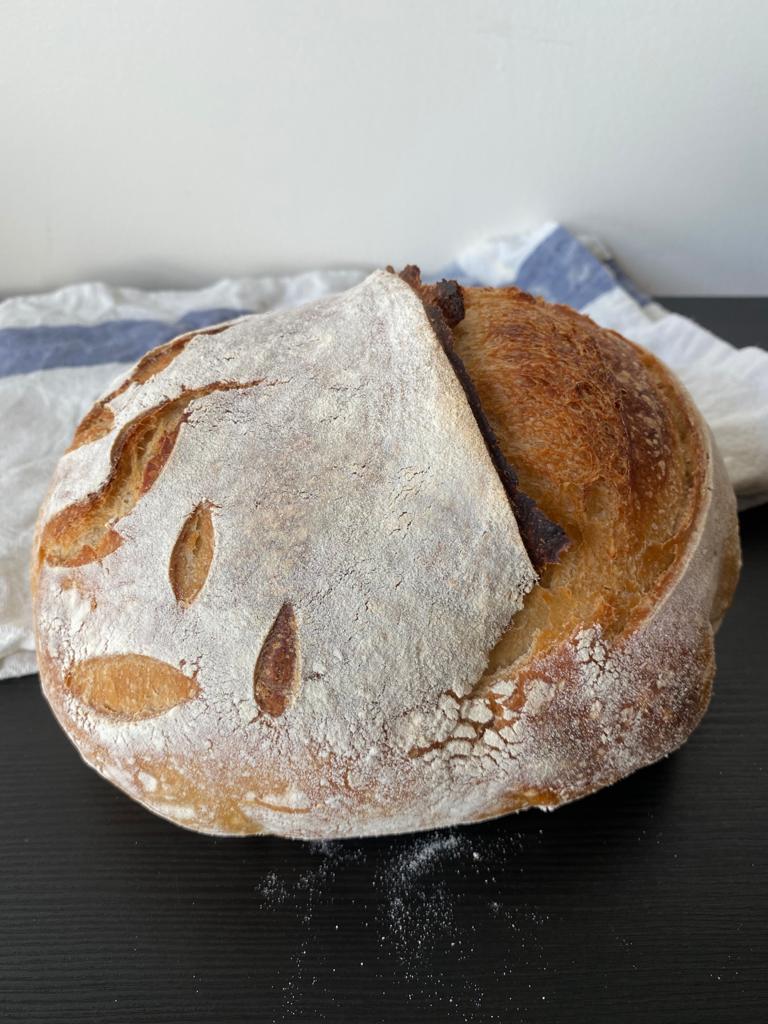
1 small bread, 8-12 slices?
Ingredients
- 240-300 g (80-100 %) white or bread flour
- 0-60 g (0-20 %) other flour (rye, buckwheat, whatever)
- 174 g (58 %) water (this depends on the protein in the flour. see below)
- 90 g (30 %) sourdough starter
- 6 g (2 %) salt
- add-ons: honey, oats, olives, etc…
Recipe
- A sourdough starter is made like this: equal weight (20 g) of a dark flour (rye or whole wheat) and water. Put in a jar, let grow for 24 h. Feed once per day (weigh out 20 g of starter, add equal weight flour and equal weight water) until it rises and falls in 6 hours and smells nice. Then feed it twice a day or store in fridge and feed once a week. The day of the bread, feed it more, pick it up just before it starts falling.
- Mix flour(s), sourdough and most of the water, not all. Mix well. Cover, rest 30 min.
- Add rest of water and salt, crunch in, cover, rest 30 min.
- Stretch and fold in the four corners of the dough one after the other to develop gluten. Cover, rest 30 min. Do this step 3-4 times or until it passes the window pane test. Or you can do letter folds (stretch out, fold in thirds in one direction then the other).
- Form: fold the dough onto itself and pinch. Roll into a ball, rest overnight in fridge (in a bannetton if available, until you can poke 1 cm deep and it refills slowly).
- Heat up oven to 250 °C with a pot in it.
- When hot, put the bread in, cook with lid on 20 min.
- Lower to 200 °C, lid off, 15 min (this makes for a dark very cooked bread).
from @memoirsofabaker on instagram, the best bread blog
the new passion I took in during the 2020 confinement.
Experience
- a lot of water makes it hard to handle, especially with normal flour. I tried 65-70 % and sometimes it was a mess, sometimes not.
- the amount of water depends on the protein content of the flour. 10-12%: 60% hydration. 13-14%: 65% hydration. above 15%: above 70% hydration. The best is to test the flour: mix 40 grams with the different percent of water. Wait 30 min. See if there’s a windowpane effect or if the dough breaks. If there’s window pane, it’s a good percentage. from the bread code who has all the nerdy sciency stuff for sourdough.
- 20/11/2020: flour from Stiebel, 60% hydration, autolyse of flour and water overnight, starter with rye flour, 3 series of folds, then in the fridge for 2 days. 250C for 20 min, 200C open for 15 min. Flavorful, well hydrated, very manageable, nice rise, the crust is thin and not crispy though.
- 30/08/2021: I made a couple breads lately. Bread flour from Stybel, starter with same flour. 1: sourdough discard grown on the counter overnight, parallel autolyse of flour and water, 4 series of fold, in the fridge for 24h, 230C for 35 min (300g ref), then open for 10 min, it was a freezbie. I guess the starter was not ready! Sourdough discard from fridge can’t be used as such. 2: proper starter grown overnight, parallel autolyse, 5 series of folds for 2h30, then 5 h on the counter. It seemed when taking it out of the basket that it was overgrown, it didn’t hold itself together well. 230C for 30 min (400g ref) then open for 15 min. It was not cooked inside. Although scared, it didn’t rise.
- 10/09/2021: on a 400 g basis. Used 360g bread flour, some from stybel and some from this new Haifa flour brand at 13.5% protein. 40g buckwheat flour. Overnight autolysis with 70% water (nice window pane). Starter overnight fed with 300% of its own weight with whole wheat bread flour, 300% own weight water. It was far from doubled in size in the morning (starter was taken out of the fridge and refed only since 2 days), so I added 3/8 tsp yeast. 2% salt. Coil folds every 30 min for 2h30-3h, then shape. Kinda seems ready to bake, so heated up oven to 230C, fan, for almost an hour. Turned to 230C up and down heating. Lots of flour and cross scar. It went flat quickly – maybe over grown, or maybe not enough dough strength, the coil folds are not enough. Put in the cast iron skillet, 25 min lid on with a dish with water at the bottom, then 20 min lid off. It looks beautiful, although a bit dark on the top, and tastes great, even though not crazy sourdoughy.
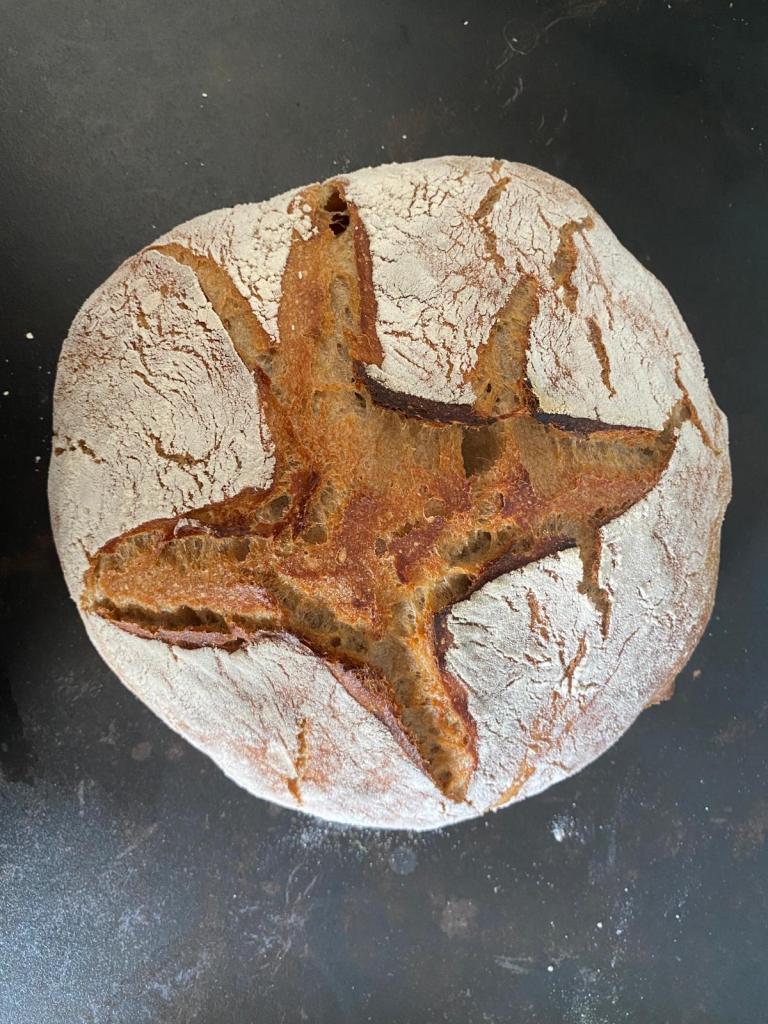
- 12/10/2021: on a 500 g basis. 460g bread flour from Haifa, 40g buckwheat flour. Autolysis 30 min with 70% water but some was left out to dissolve salt and 20% sourdough starter (rye based) fed 12 hour before 1:1:1. Then water added with 2% salt, but too much water (I had to remeasure by eye cause Matt trashed the salty water), then added more flour. 30 min, stretch and fold, 2 h, shape, in fridge overnight with new covers that actually dry the bread so that’s not great. Oven 230C with fan for preheating then without fan for baking, not dutch oven only the plate with a vessel of water below, some water around the bread and a bowl over the bread. 30 min covered 230C. 20 min uncovered 230C. bread flattened out and did not expand upwards nicely but still tasted fine.
- 15/10/2021: on a 500 g basis. 460 g bread flour from Haifa, 40 g buckwheat flour. Autolysis overday with 70% water. Sourdough starter (rye based) fed in the morning 1:1:1. In the evening, flour and water and 20% sourdough and 2% salt. Stretch and folds every 30 min over 2h30. Afterwards I still feel like the dough is falling back and not holding its shape, and I’m not sure how much it’s grown – ie if bulk fermentation is over). Shape, roll on the counter, put in basket. In the fridge 18 . Oven 230C with fan for preheating, forgot to remove it for baking I think, with dutch oven. Lid on 30 min, lid off 20-25 min. Very pretty, although it 0% opened where I slashed it and instead cracked on the top – this might have to do with the sliding into the dutch oven, where the cut gets pressed back together. Increased in a dome shape with a lot of large air pockets at the top: no enough humidity? At any rate a very good bread.
- 22/10/2021: on a 500 g basis. 420 g bread flour from Haifa, rest whole wheat bread flour from Haifa. Autolysis overday with 70% water, a bit more even. Sourdough starter (rye) fed in the morning 1:1:1. Evening: flour and water and 20% sourdough and 2% salt. Stretch and folds every 30 min over 2h, then left on the counter for 3-4 more hours. With a sample taken out that grew maybe 50% in size over 3-4 hours and then stagnated. Jiggly but does not keep its shape. Shape, put in basket, proof a few hours at room T until poke test passes. In the freezer while oven preheats, then scored in the dutch oven then baked. It seemed to flatten out completely but rised and made a beautiful bread with the best air pockets I’ve seen. 30+20 min at 230C. It did not have an ear though. Dough not passed through the fridge is a lot harder to handle.
New recipe and experience 2023
05/2023: my typical recipe for the microbakery is based on 500g bread flour, 70% water, 20% sourdough starter, 2% salt. Autolyse overnight. Bulk fermentation for 2-3 hours. Folds every 20-30min. Shape, proof in fridge. Bake 250C 30min with vapour, 15 min without vapour, maybe flip to bake the bottom. I do a rye bread 50% rye flour 50% bread flour, and a whole wheat that’s 100% whole wheat flour.
12/2023: 405g bread flour, 45g whole wheat flour, 315g water, 9g salt. In the oven after overnight cold proof, oven 230C dutch oven rotating, 20-25 min in, then take out and bake for 12 min.

 Aurore's cookbook
2 thoughts on “Sourdough bread”